An insulated bag has no universal dry-ice hold time. First confirm that the exact bag construction is permitted for solid carbon dioxide and that the complete package can release CO₂ gas. Then test the loaded bag, closure, seams, coolant placement and payload under a defined route profile. The useful hold time ends when the payload leaves its specified temperature range, even if some dry ice remains.
Confirm the bag is compatible with solid CO₂ before testing duration
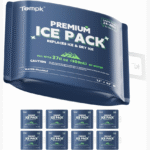
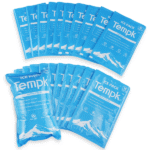
“Dry ice pack” is sometimes used for a frozen gel or hydratable coolant pack. Those products are not solid CO₂ and do not create the same gas-release requirement. Identify the coolant with the dry ice pack versus dry ice guide before applying this page.
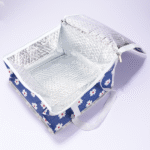
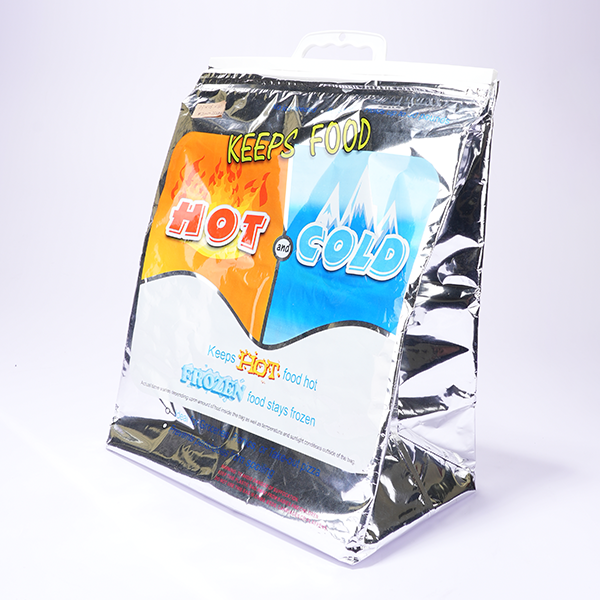
For solid CO₂, obtain written information for the exact bag model: shell, insulation, liner, zipper or closure, stitching or welds, temperature limits and intended use. A bag designed for lunch delivery or reusable gel packs is not automatically suitable for dry ice. Do not add tape, clamps or an inner sealed liner that could obstruct the package’s intended gas release.
If the manufacturer does not permit dry ice or cannot explain the complete-package gas-release arrangement, use a packaging system designed for dry ice. The separate soft-cooler compatibility guide covers this initial go/no-go decision.
Bag features that can shorten or invalidate hold time
| Bag feature | Failure question | What to record in the trial |
|---|---|---|
| Closure | Does the zipper, roll-top or flap close consistently at the intended fill level without creating an airtight package? | Closure method, overlap, zipper position, fasteners and operator steps. |
| Seams and corners | Do stitched, welded or folded areas open, crack or create local heat paths when loaded? | Seam type, photos, pre-test condition and post-handling damage. |
| Flexible walls | Does compression move the coolant, reduce separation or press very cold material against the payload? | External restraint, stacking load, wall deflection and coolant movement. |
| Insulation continuity | Are there thin areas at the lid, zipper, handles or fold lines? | Construction drawing, thickness transitions and suspected warm locations. |
| Usable volume | Can the payload, separator, void fill and coolant fit without forcing the closure? | Payload mass, fill level, headspace and final packed dimensions. |
| Outer protection | Can parcel handling puncture, crush, abrade or overturn the flexible bag? | Overpack, orientation, handling profile and damage inspection. |
The weakest point may be the closure or a compressed corner rather than the broad wall panel. A foil surface or insulation label does not reveal the performance of those local details.
Define useful hold time for the payload, not for the bag label
Begin with the general dry ice hold-time planning method. Define the clock from final closure to receipt, add a credible delay, and state the payload’s allowable temperature range. This page then tests what the flexible bag changes.
| Result | What it tells you | What it does not prove |
|---|---|---|
| Payload temperature trace | Whether monitored locations remained within the acceptance range. | Performance at unmonitored locations or in a changed packout. |
| Ambient temperature trace | The exposure applied around the bag during the trial. | That every future route will have the same exposure. |
| Residual dry ice mass | How much solid CO₂ remained at the measurement time. | That all payload locations stayed acceptable. |
| Closure and seam inspection | Whether the bag retained its intended configuration after handling. | That an untested fill level or operator method will behave the same. |
| Repeat test agreement | Whether the result is reproducible for the defined configuration. | That different bags, payloads, routes or seasons are covered. |
Remaining dry ice and acceptable payload temperature are separate outcomes. The useful hold time ends at the first temperature-limit failure, not when the last dry ice disappears.
A seven-step insulated-bag hold-time trial
- Lock the bag identity. Record model, materials, insulation, dimensions, closure, condition and the manufacturer’s dry-ice instructions.
- Define the payload and route. Record payload limits, mass, starting temperature, route time, handoffs, seasonal exposure and delay case. The Route Risk Checker can help structure the route questions.
- Document the packout. Fix the dry ice form, starting mass and placement, separators, void fill, payload layout and closure steps. Do not improvise a sealed liner.
- Place sensors deliberately. Monitor justified warm-risk and cold-risk payload locations, plus the ambient exposure. Do not rely on one logger in the center.
- Apply handling before or during exposure. Reproduce relevant compression, orientation changes, drops or openings without departing from the intended use.
- Run the defined thermal profile. Keep the configuration closed except for planned opening events. Record timestamps, temperatures and any physical changes.
- Review and release. Compare every payload trace with acceptance criteria, inspect the bag and record residual dry ice. Approve only the tested configuration and define change-control triggers.
Common failure patterns and what they mean
- One warm corner fails first: investigate seam, fold, handle or closure heat paths and sensor placement before adding more dry ice.
- Payload nearest the coolant becomes too cold: review separation, coolant placement and compression rather than assuming colder is always safer.
- The zipper cannot close at production fill: the trial packout is not operationally repeatable; reduce fill or use a larger approved system.
- Performance changes after handling: flexible walls or components moved. Add appropriate outer protection or redesign the layout.
- Dry ice remains but payload fails: coolant presence alone did not control all product locations.
For quantity work in a defined rigid cooler, use the large-cooler dry ice calculation guide. Do not transfer that result to a flexible bag without testing the bag configuration.
Safety, gas release and transport controls
Dry ice releases carbon dioxide gas and a dry-ice package must not be airtight. The FAA shipper fact sheet says packaging must permit gas release and air shippers must arrange with the carrier. The current U.S. requirements for air and water transport are in 49 CFR 173.217.
Helpful decision tools
Check the details before you choose packaging
These quick tools can help you compare route risk, sizing needs, coolant choices, and packaging details before you request a quote.
Coolant & PCM Reference
Compare coolant and PCM options when a route needs added temperature support.
Compare optionsBox Liner & Pallet Cover Sizing
Check box liner and pallet cover sizing logic for insulated packaging projects.
Estimate sizingDry Ice Calculator
Estimate dry ice needs for frozen or ultra-cold shipments before packing.
Estimate dry iceA test that keeps cold well is not automatically a compliant transport package. Confirm bag compatibility, package-level venting, markings, documentation, carrier acceptance and any destination requirements for the actual shipment. Protect workers from cold contact and avoid dry ice in poorly ventilated enclosed spaces.
How to document evidence and control later changes
ISTA describes Standard 20 and 7E as a framework for designing, testing and qualifying a specific insulated shipping container against thermal profiles. The ISTA process standards overview is a useful reference for a controlled qualification approach. Select the profile and acceptance method appropriate to the actual product, route and quality system.
Retain the bag and component identifiers, supplier instructions, packout drawing, operator steps, coolant and payload weights, starting temperatures, sensor serial numbers and locations, ambient profile, time series, deviations, damage photos and decision. Reassess when the bag construction, closure, payload, coolant, route, season or handling changes.
For the wider system architecture and qualification record, use the dry ice packaging design and validation guide.
Frequently asked questions
Can I calculate dry ice quantity from bag volume alone?
No. Volume does not capture closure, seam, insulation, compression, payload, starting temperatures or route exposure. Use an estimate only to choose a trial starting point, then test the exact bag configuration.
Should I tape every seam to keep cold in?
No. Do not modify the bag in a way that departs from the manufacturer’s approved use or obstructs required gas release. Investigate the actual heat path and use a packaging system designed for the application.
Does a foil liner prove that a bag is dry-ice safe?
No. A reflective liner does not establish low-temperature material compatibility, gas release, seam durability or thermal performance. Verify the complete construction and intended use.
Can one successful trial cover every bag size and route?
No. The result applies to the documented configuration and exposure it represents. Justify any family grouping and reassess changes that can alter heat gain, coolant position or payload response.