


Fresh Pasteurized Milk
Plan for chilled control, upright bottles, cap leakage, absorbent liners, dry labels, and enough coolant without freezing the liquid near pack surfaces.
Dairy shipments need chilled control, but milk, yogurt, and cheese do not fail in the same way. A useful packout must control route temperature while protecting bottle seals, cup lids, retail cartons, moisture behavior, odor separation, and the product condition the receiver can actually inspect.
Start with the product shape and the shipment promise. Liquid milk needs upright support and absorbent protection. Yogurt needs cup and lid protection. Cheese needs moisture, odor, and texture control. Tempk adjusts insulation, conditioned coolant, liners, inserts, and receiving checks around these differences.
Plan for chilled control, upright bottles, cap leakage, absorbent liners, dry labels, and enough coolant without freezing the liquid near pack surfaces.
Protect cup lids and stacked trays while controlling condensation, texture risk, and carton strength through warm last-mile routes.
Use a buffered chilled layout that prevents sweating, odor transfer, freeze marks, and retail-pack compression.
| Product route | Temperature intent | Packaging setup | Preliminary coolant range | Check at receiving |
|---|---|---|---|---|
| Fresh pasteurized milk parcel or local delivery, 4-24 h | Keep the route chilled according to the product requirement; many dairy operations plan around 0-4 C or 2-8 C and avoid freezing. | Insulated carton or EPP box, upright bottle divider, absorbent liner, conditioned gel packs or PCM on side/top positions with a separator. | About 1.0-2.8 kg conditioned gel packs or PCM for a 2-6 L milk payload; increase insulation before adding excessive frozen mass. | Product temperature, cap leakage, bottle movement, label dryness, carton moisture, and remaining coolant. |
| Yogurt cups or multipacks, 8-24 h | Use a chilled route that prevents warming while avoiding cold contact on cup lids and sidewalls. | Insulated carton or compact EPP shipper, tray support, cup-lid buffer, liner for condensation, conditioned coolant placed around the tray. | About 1.2-3.2 kg conditioned gel packs or PCM for 12-24 retail cups, adjusted by ambient profile and carton size. | Cup lids, carton compression, texture, label wetting, minimum temperature, and remaining coolant state. |
| Cheese blocks, wedges, or retail packs, 12-36 h | Chilled handling based on product type; avoid direct freezing and large temperature swings that create sweating. | Insulated carton or EPP box, moisture/odor barrier, protected center cavity, conditioned coolant separated from retail packs. | About 1.0-2.8 kg conditioned gel packs or PCM for a 3-8 kg cheese payload; validate for warm lanes or mixed loads. | Package dryness, texture, odor transfer, carton pressure, logger record if used, and remaining coolant. |
These are planning ranges for sampling and quotation. Final coolant mass and shipper size should be tested with the actual product count, carton dimensions, product temperature, route duration, ambient profile, and receiving requirement.
The parcel should maintain a cold product, not remove heat from warm milk, yogurt, or cheese. Start from the product’s normal chilled condition.
Use conditioned gel packs or PCM with a spacer. Direct frozen contact can create local freezing, wet labels, and package marks even when the average route temperature looks acceptable.
Milk bottles need upright dividers, yogurt needs cup-lid and stack support, and cheese needs a protected center cavity with moisture and odor control.
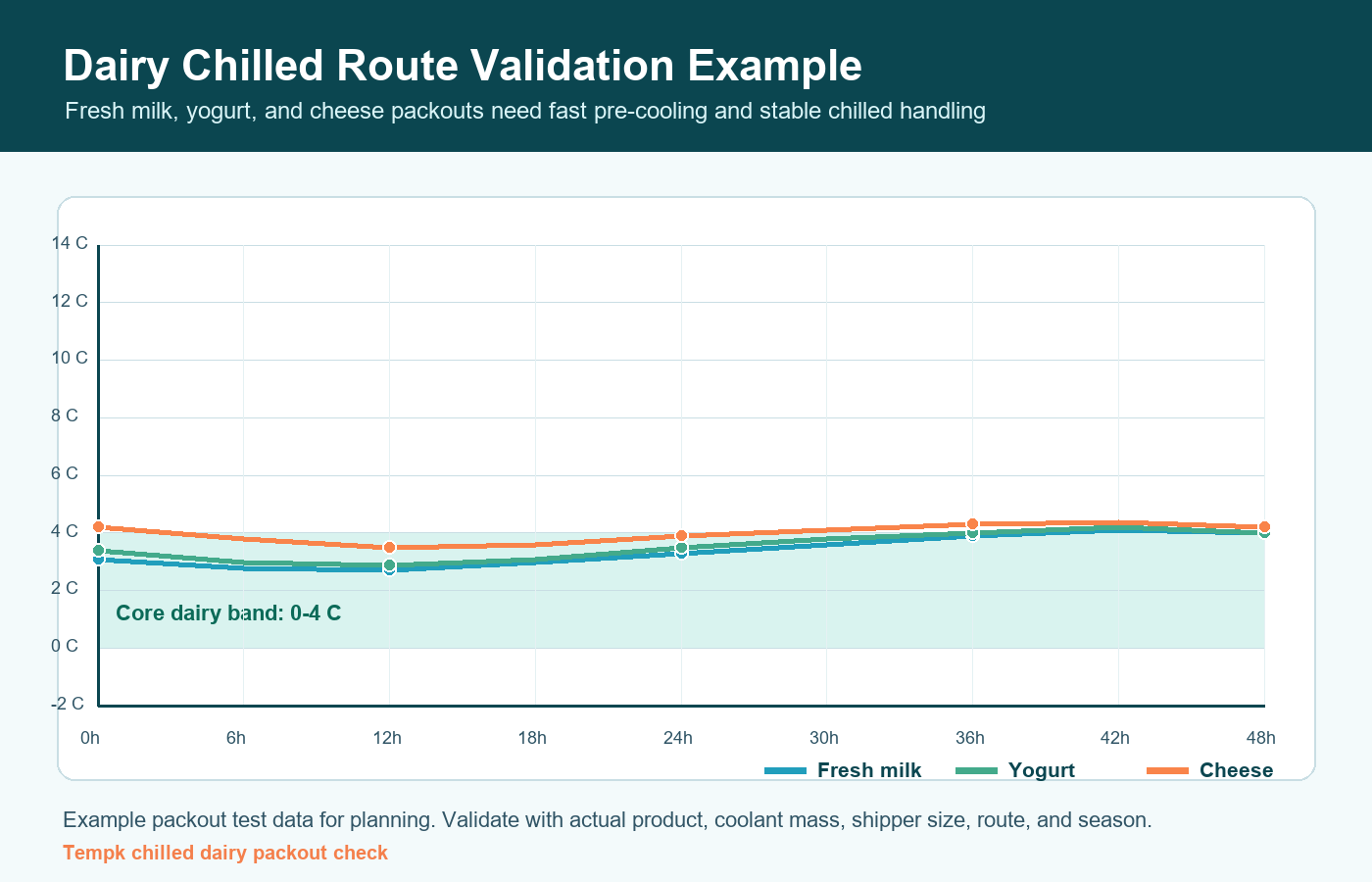
Read the logger with the receiving notes: leakage, carton dryness, lid condition, product texture, odor transfer, package compression, and remaining coolant.
The dairy test curve helps compare chilled parcel behavior for liquid, cultured, and solid dairy formats. For dairy, the visual arrival condition can be as important as the temperature curve.
Use these guides for related dairy products that need focused handling notes without adding another dedicated solution page.
Use these pages to compare coolant mass, route risk, insulation choice, and nearby product routes before the validation run.
Milk, yogurt, and cheese share chilled distribution needs, but their damage patterns differ. A useful dairy packout is based on leak risk, texture, and condensation control.
Losses include sour odor, swollen containers, yogurt syneresis, cheese sweating, wet labels, and cartons weakened by liquid leakage.
Use leak control for liquids, upright support for yogurt cups, and breathable wrap decisions for cheese. Keep coolant separated so labels and paperboard stay dry.
Use chilled gel packs for 0 to 4 C or 2 to 8 C dairy lanes. PCM helps where final-mile dwell is long or summer route temperatures are high.
Receiving should check product temperature, container leakage, label condition, and texture after the product rests.
Custom packout support
For fixed carton sizes, payload limits, branding requirements, seasonal lanes, or validation targets, Tempk can adapt this solution into a custom cold-chain packout.
Share the dairy product, target temperature, unit count, payload weight, carton dimensions, route duration, ambient condition, and receiving checks. Tempk can help compare insulation, conditioned gel packs, PCM, liners, inserts, and logger placement.
Request a packout review