


Red Blood Cells
Protect the refrigerated range while preventing direct frozen coolant contact, bag pressure, wet labels, and missing arrival records.
Blood product packaging starts with the component, not the box size. Red blood cells, platelets, and fresh frozen plasma need different temperature logic, coolant contact protection, bag support, handoff control, and receiving records.
A universal medical shipper can create real risk when the payload changes. The same coolant that supports red cells can chill platelets, and the dry ice used for frozen plasma can damage bags or documents if it is not separated.
Protect the refrigerated range while preventing direct frozen coolant contact, bag pressure, wet labels, and missing arrival records.
Use a no-chill route plan with controlled room-temperature buffers, stable bag support, and short validated handoff windows.
Maintain frozen condition with dry ice or frozen-route support, while keeping bags, labels, and documents away from direct dry ice damage.
| Component route | Temperature intent | Packaging setup | Coolant or dry ice planning | Receiving check |
|---|---|---|---|---|
| Red blood cells, facility-to-facility or courier route | Plan around refrigerated handling, commonly 1-6 C for storage-aligned control. Avoid freezing and avoid warm handoff delays. | Qualified medical insulated shipper, absorbent secondary containment, bag support insert, coolant barrier, logger near payload but not touching coolant. | Use conditioned refrigerated gel packs or 2-8 C PCM behind a divider. For a 3-8 L shipper, many trials start around 0.8-2.5 kg coolant; larger lanes require lane testing. | Arrival temperature record, bag condition, no ice contact marks, dry documents, intact labels, and handoff time. |
| Platelets, short controlled room-temperature lane | Plan around 20-24 C handling where required by SOP. Do not use chilled parcel logic. | Controlled room-temperature insulated shipper, bag support, no frozen gel packs, logger at likely warm and cool positions. | Use 20-24 C PCM only after validation. For small parcels, trials often start with 0.8-2 kg room-temperature PCM; mild same-day lanes may need insulation and records more than coolant. | No chill exposure, no overheating, stable bag position, route duration, handoff notes, and logger curve. |
| Fresh frozen plasma, frozen courier or air lane | Maintain frozen condition, commonly -18 C or colder for frozen plasma handling. Prevent thaw during transfer and delay. | Frozen medical shipper, dry ice separation layer, rigid bag support, absorbent or leak-resistant liner, vented shipper and documents protected from frost. | Dry ice trials often start around 1-3 kg for short parcel lanes, 3-8 kg for 8-24 h lanes, and higher for long or hot routes. Use the dry ice calculator and validate with the real lane. | Temperature record, frozen arrival condition, no bag puncture or dry ice burn, remaining dry ice, dry documents, and receiving delay. |
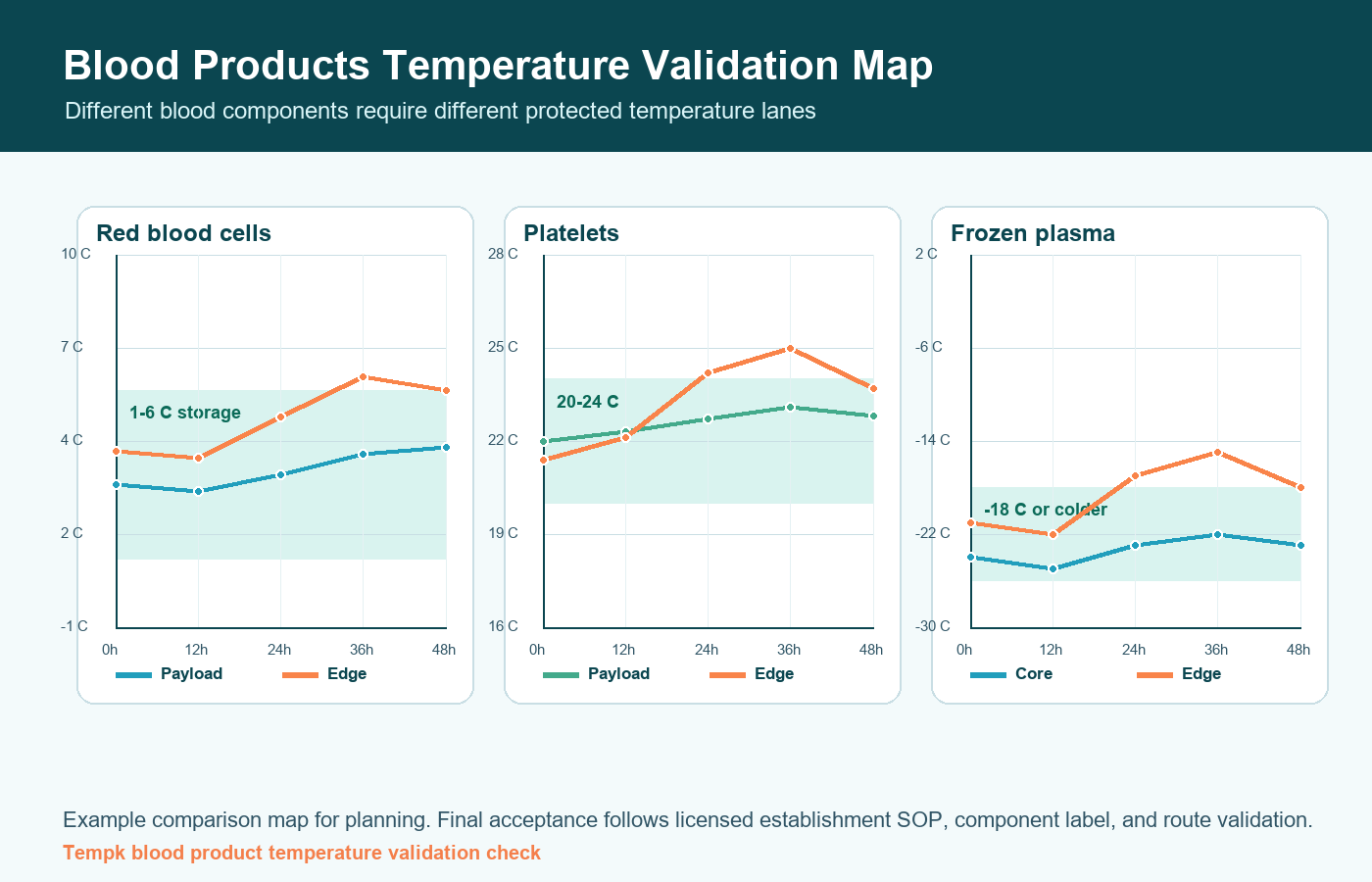
These are planning ranges for packaging discussion. Final acceptance must follow the blood center, hospital, laboratory, courier, and local regulatory procedure for the exact component and route.
Use the validation curve to compare refrigerated, controlled room-temperature, and frozen behavior before scaling a route. The curve should be reviewed with receiving notes, not as a standalone pass or fail.
Whole blood and cryoprecipitate need separate handling decisions, so they are better handled as focused guides rather than being folded into one generic page.
Controlled refrigerated whole blood transport with bag support, freeze-contact protection, monitoring, and records.
Frozen cryoprecipitate transport with thaw protection, dry ice separation, container support, and validation.
Use these pages to check route risk, coolant choice, insulation structure, nearby medical routes, and final packout questions before validation.
Blood Products shipments should not use one fixed box recipe for every product. Start with component-specific control such as 1-6 C red cells, 20-24 C platelets, or frozen plasma conditions, then separate products by heat load, packaging strength, and how they are received. For mixed programs, Tempk usually compares a short local route, an overnight parcel route, and the hottest expected season before confirming the shipper.
Use validated medical shipper, absorbent secondary containment, logger, and clean handoff documentation. The coolant plan should begin with component-matched PCM, gel packs, or dry ice with separation from bags and labels. When the payload has delicate retail cartons, soft texture, live material, or medical documentation, protect the payload first and then add cooling capacity. If the shipment is delayed at packing, handoff, customs, or dock transfer, the route profile should be rechecked instead of only increasing coolant weight.
Validation should include check component temperature, bag protection, traceability record, and receiving acceptance criteria. A useful test records the warmest payload point, the coldest point near coolant, and the receiving condition after handling. This gives the operations team a practical packout instruction, not just a temperature chart.
Custom packout support
For fixed carton sizes, payload limits, branding requirements, seasonal lanes, or validation targets, Tempk can adapt this solution into a custom cold-chain packout.
Share the component type, payload count, bag or container size, target range, lane duration, ambient condition, courier steps, handoff limit, and receiving checks. Tempk can help compare the shipper, coolant layout, support insert, monitoring position, and validation plan.
Request a packout review