


Monoclonal Antibodies
Plan a 2-8 C route around no-freeze protection, carton support, controlled PCM contact, and logger placement at both warm and cold risk points.
Biopharmaceutical shipments should be planned from the product form first: refrigerated antibodies, cryogenic cell therapies, and frozen gene therapy vectors do not fail in the same way. Tempk helps map the temperature range, shipper structure, coolant or dry shipper choice, monitoring position, and receiving checks before route validation.
A single medical parcel setup can be too warm for one product and too cold for another. The useful first step is to separate the payload by risk: freeze-sensitive refrigerated biologics, living cell products that may require vapor-phase liquid nitrogen, and vectors that often need frozen or ultra-low frozen control.
Plan a 2-8 C route around no-freeze protection, carton support, controlled PCM contact, and logger placement at both warm and cold risk points.
Use the product SOP to decide whether a vapor-phase liquid nitrogen dry shipper is required, then protect chain of identity, orientation, and hold-time margin.
Choose dry ice or a dry shipper only after the labeled storage range is clear. Prevent thaw, refreeze, vial pressure, frost damage, and paperwork loss.
| Product route | Temperature intent | Packaging setup | Coolant or dry shipper planning | Receiving check |
|---|---|---|---|---|
| Monoclonal antibodies, sample or commercial 2-8 C lane | Hold the labeled refrigerated range and prevent freezing at the coolant face. | Qualified insulated shipper, payload carton support, foam or corrugated divider, condensation control, and a logger near the likely warm and cold positions. | Use conditioned 2-8 C PCM or refrigerated gel packs behind a barrier. For a small 3-8 L shipper, many trials start around 0.8-2.5 kg coolant, then adjust by season and lane. | Temperature curve, carton condition, no frozen coolant marks, label readability, and receiving time. |
| Cell therapy products, cryogenic hospital or manufacturing route | Follow the product SOP. When cryogenic control is required, keep the payload in a validated vapor-phase liquid nitrogen dry shipper. | Pre-charged dry shipper, cassette or canister fit check, secondary containment, tamper seal, orientation control, chain-of-identity and chain-of-custody paperwork. | Plan by validated hold time, not ice-pack mass. Route time should leave reserve margin for pickup, flight delay, customs, and receiving readiness. | Dry shipper condition, custody record, orientation or shock indicator, remaining hold-time record, and receiver signoff. |
| Gene therapy vectors, frozen or ultra-low frozen lane | Use the labeled range, often frozen or ultra-low frozen. Avoid thaw and refreeze during packout or handoff. | Dry ice shipper or dry shipper as required, vial rack support, dry ice separation, vented outer package, document sleeve protected from frost and moisture. | If dry ice is allowed, small parcels often begin trials around 3-7 kg for 0-24 h lanes and 8-15 kg for 24-48 h lanes. Use a validated dry shipper when the product requires LN2 conditions. | Logger record, remaining dry ice or shipper hold margin, no vial movement, no frost-damaged documents, and immediate freezer transfer. |
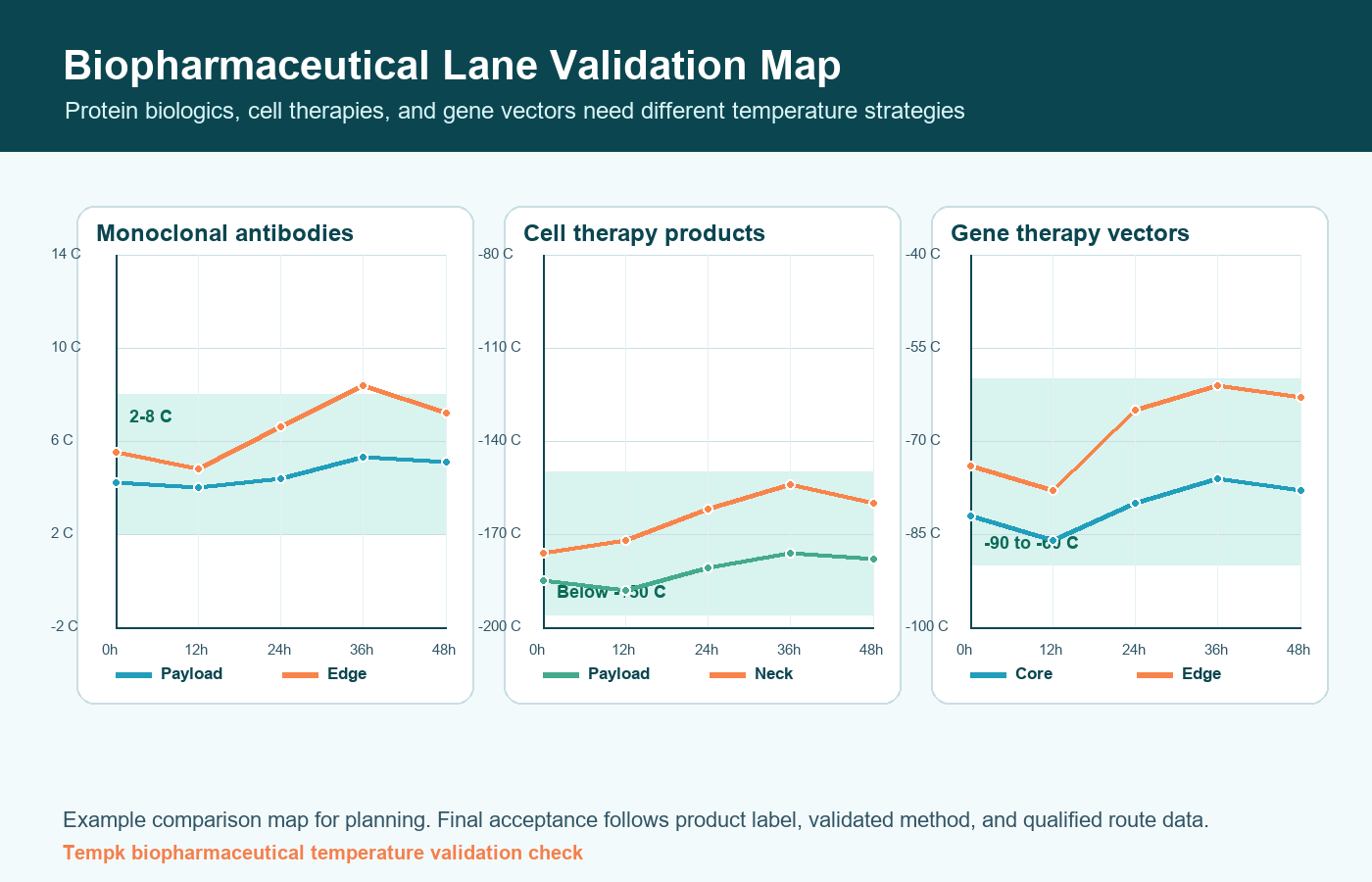
These ranges are planning examples for packaging discussion. Final packout acceptance must follow the product label, sponsor SOP, lane qualification, carrier rules, and local regulatory requirements.
Use the curve to compare refrigerated, cryogenic, and frozen behavior before you repeat the route. A useful review combines the logger curve with payload condition, pickup delay, transfer steps, and receiving notes.
Recombinant proteins and enzyme replacement therapies also need product-specific handling, especially for freeze sensitivity, aggregation control, vial support, and records.
2-8 C packaging with no-freeze protection, aggregation-aware handling, carton support, monitoring, and receiving records.
Refrigerated therapeutic packaging with vial protection, no direct frozen coolant contact, controlled handoff, and route checks.
Use these pages to compare coolant behavior, route risk, shipper structure, and nearby medical cold chain cases before requesting a sample or lane test.
Biopharmaceutical shipments vary widely. Monoclonal antibodies may need 2 to 8 C protection, cell therapy may require cryogenic control, and gene therapy vectors may require deep frozen handling.
The most serious risks are freezing of refrigerated biologics, dry ice depletion on deep frozen lanes, shock exposure, and incomplete chain-of-custody records.
Use a payload cavity sized to the vial, bag, or cassette and protect it from movement. Documentation and temperature logging should be planned as part of the packout.
Choose 2 to 8 C PCM, dry ice, or cryogenic equipment according to the product label and validation requirement. These systems should not be interchanged casually.
Validate lane, duration, handling orientation, and handoff documentation. Receiving checks should include payload condition and logger review.
Custom packout support
For fixed carton sizes, payload limits, branding requirements, seasonal lanes, or validation targets, Tempk can adapt this solution into a custom cold-chain packout.
Share the product type, labeled temperature range, payload size, route duration, lane temperatures, handoff limits, monitoring requirement, and receiving process. Tempk can help compare the insulated shipper, PCM, dry ice, dry shipper, support insert, and validation plan.
Request a packout review