


Cold face freeze risk
Frozen gel packs can create a local cold spot even when the center logger remains inside the expected range.
Monoclonal antibodies are often shipped as refrigerated biologics, where the main packaging problem is not simply staying cold. The packout has to prevent heat exposure, freezing at the coolant face, carton crush, condensation, and vibration-related stress during handoff.
The product label and sponsor SOP decide the final range. For packaging planning, the common risks below are the ones to remove before route validation.
Frozen gel packs can create a local cold spot even when the center logger remains inside the expected range.
Pickup, aircraft transfer, warehouse dwell, and receiving delay often create the warmest point near the top or outer wall.
Moisture, tight dividers, or heavy coolant can damage secondary cartons, labels, and serialized paperwork.
| Route condition | Temperature intent | Packaging setup | Coolant or dry shipper planning | Receiving check |
|---|---|---|---|---|
| Controlled courier or clinic delivery, 0-8 h | Maintain 2-8 C planning while avoiding any freeze contact. | Pre-conditioned EPP or insulated carton shipper, payload sleeve, moisture barrier, and one logger near payload. | For a 3-8 L shipper, trial 0.8-1.5 kg conditioned 2-8 C PCM or refrigerated gel packs behind a divider. | No cold marks, label dry, carton intact, temperature record, and handoff time. |
| Parcel or specialty courier, 8-24 h | Hold refrigerated range through pickup, sortation, and receiving delay. | Higher insulation, top and side buffer pads, separated PCM layer, two logger positions for warm edge and cold face. | Start small-lane trials around 1.5-3.5 kg 2-8 C PCM. Increase coolant only after cold-spot review. | Warm edge, cold face, carton crush, condensation, and receiver delay. |
| Hot season or international route, 24-48 h | Prevent heat exposure without creating freeze risk during preconditioning or flight transfer. | Validated shipper, seasonal lane profile, payload spacer, absorbent or moisture-control layer, and receiver-ready handoff plan. | Longer lanes may need 3-6 kg PCM in a larger shipper. Use route testing before live commercial shipments. | Full curve review, remaining coolant condition, no wet paperwork, and receiver signoff. |
Use these values as starting points for sampling and quotation. Final coolant, PCM, dry ice, insulation, dry shipper, logger, and handling choices must be validated with the real payload, lane, carrier process, season, and receiving procedure.
Load the antibody cartons into a stable packout. Do not use the shipper to cool a warm payload.
Keep PCM or gel packs behind foam, corrugated, or molded spacing so cartons cannot touch a frozen or over-cold surface.
Use dividers that hold the carton without compression and keep paperwork away from condensation zones.
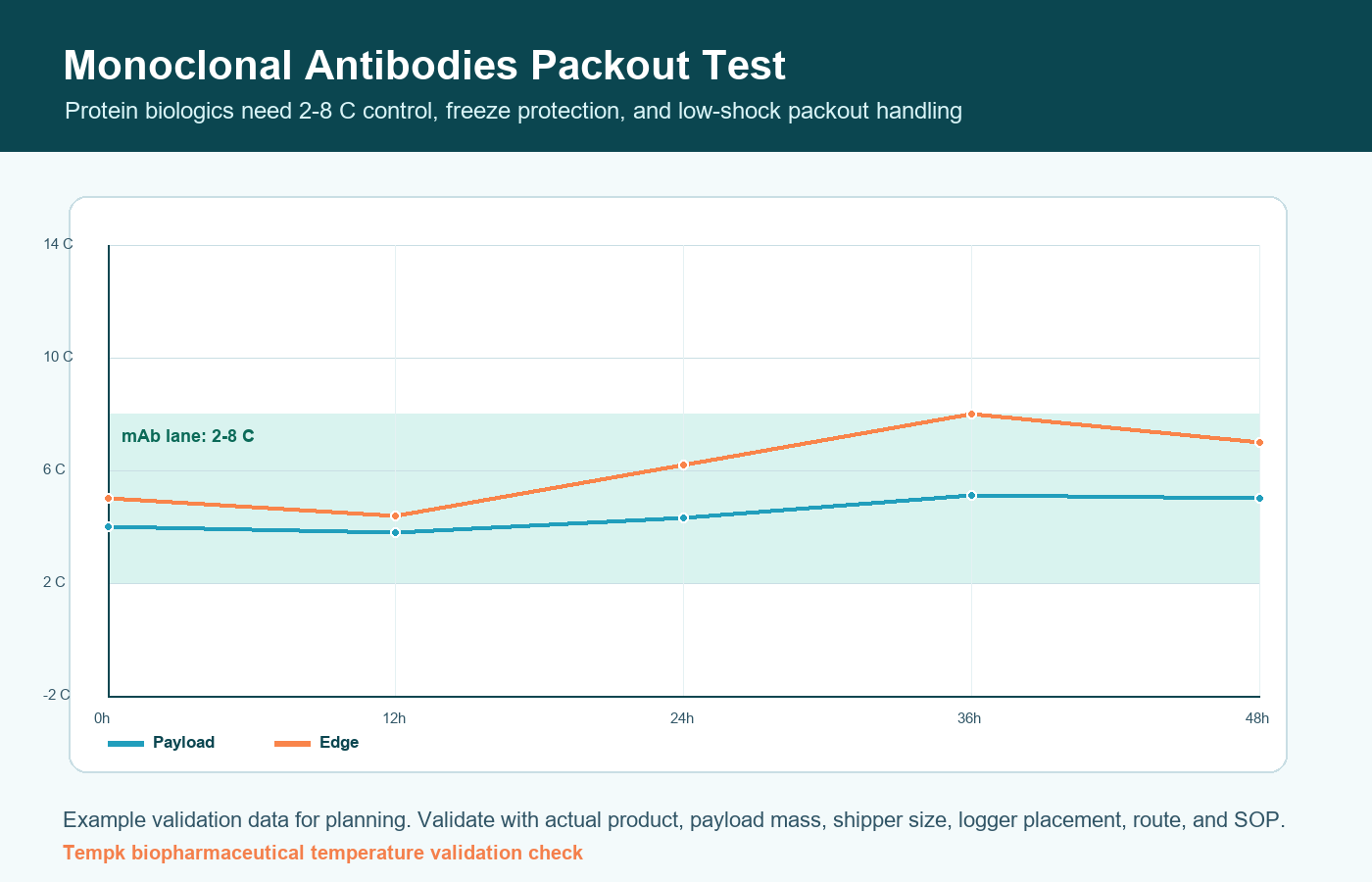
During testing, place sensors at the likely warm edge and the coolant-side risk point, not only in the center.
These are the visible and operational problems the packout should reduce before the shipment reaches the receiver.
Use the test curve as a working comparison, then validate with the actual payload, shipper, coolant or dry shipper configuration, lane duration, ambient profile, and receiving process.
Use these pages to compare nearby biopharmaceutical routes, coolant choices, insulation options, and route-risk questions before sampling.
Monoclonal antibodies are commonly refrigerated biologics where freeze exposure and vibration can threaten product quality. The packaging should hold temperature and protect vials or prefilled units.
Key risks are freeze contact, vial breakage, carton crush, temperature logger misplacement, and delayed hospital receiving.
Use a qualified payload cavity with vial dividers or carton support. Keep coolant behind spacers and add cushioning where the lane has high handling intensity.
Use 2 to 8 C PCM or conditioned gel packs for validated refrigerated lanes. Avoid dry ice unless the product is labeled for frozen transport.
Check logger data, vial condition, carton integrity, and receiving time. Include a vibration-sensitive lane if air express handling is expected.
Monoclonal antibodies need stable refrigerated transport and protection from freezing. The packout should hold vials or cartons securely so vibration and impact do not become a hidden risk.
Use 2 to 8 C PCM or conditioned gel packs behind spacers. Add vial dividers, a protected payload cavity, and a logger placed with the medicine rather than beside the coolant.
Tempk validation should include vial count, carton size, route duration, air express handling, and receiving delay. Review minimum temperature, vibration-sensitive damage, carton integrity, and logger data.
Custom packout support
For fixed carton sizes, payload limits, branding requirements, seasonal lanes, or validation targets, Tempk can adapt this solution into a custom cold-chain packout.
Share the antibody presentation, carton count, target range, shipper size, route duration, ambient profile, handoff points, and logger requirement. Tempk can help compare PCM mass, insulation, divider structure, and validation layout.
Request a packout review